
NAD+ Expert Consensus
Cardiovascular diseases, type 2 diabetes, Parkinson's disease, sarcopenia in the elderly, and leukopenia after chemotherapy - these five health problems that plague many middle-aged and elderly families have recently been covered by a new national guideline.
NAD+ (nicotinamide adenine dinucleotide), an essential substance present in every cell of the human body, is closely related to the occurrence and development of these diseases.
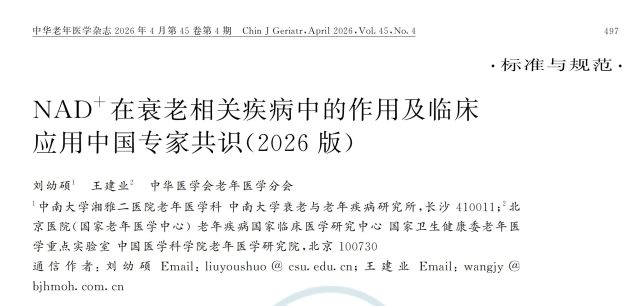
The "Chinese Expert Consensus on the Role of NAD+ in Aging-related Diseases and Its Clinical Applications (2026 Edition)" (hereinafter referred to as the "Consensus"), jointly compiled by the Geriatrics Branch of the Chinese Medical Association and involving over 30 experts, has been officially released.
This is the first authoritative academic document in China to systematically evaluate the clinical application of NAD+.
It means that doctors and patients now have a "official answer" to refer to when dealing with such issues.
Why is this consensus so important?
With the acceleration of global aging, the incidence of aging-related diseases such as metabolic disorders, cardiovascular diseases, and neurodegenerative diseases has significantly increased, placing a heavy burden on the medical system.
However, in the past, discussions surrounding how to deal with these diseases related to aging have long faced threefold challenges:
Challenge 1: Confusion of Concepts
From health supplements to various kinds of supplements, the market is flooded with products, and the promotional slogans are alluring and confusing, making it difficult for consumers to distinguish the genuine from the fake.
Problem Two: Insufficient Evidence
When clinical doctors are confronted with questions like "Can this be used for this type of disease?", they often lack authoritative and systematic reference materials.
Problem Three: Ambiguous Regulation
Both being "NAD+", they might represent different levels of products, including pharmaceuticals, health supplements, and even common food ingredients. They differ significantly in terms of usage standards, target audience, and safety requirements.
The release of this consensus is precisely in response to the above questions.
It integrates the clinical experience and evidence-based data of senior experts in China, establishing a national-level "evidence-based coordinate" for the clinical application, population screening, dosing plans, and safety assessment of NAD+.
Core content of consensus: What is relationship between NAD+ and aging?
Q1 What is NAD+? Why does it decrease with age?
NAD+ is officially known as "nicotinamide adenine dinucleotide" and it is a coenzyme that is essential for every cell in the human body.
It is involved in hundreds of physiological processes such as energy metabolism, DNA repair, mitochondrial function, and cellular stress response, and is regarded as the "core fuel" for maintaining cell vitality.
The consensus states: "As people age, the level of NAD+ in various tissues and organs of the human body significantly decreases."
Specific data shows that the levels of NAD+ in tissues such as skin, brain, heart, and liver have decreased by at least 10% to 50%.
This is precisely one of the key molecular mechanisms behind "accelerated aging".
Q2: Which five types of age-related diseases are directly related to the decrease in NAD+ levels?
The consensus clearly lists five major types of age-related diseases that are closely associated with the decline of NAD+:
① Cardiovascular diseases
The consensus suggests that supplementing NAD+ under professional guidance may have potential benefits for patients with heart failure (Class A evidence), and may also have potential benefits for patients with coronary heart disease and myocardial infarction (Class B evidence), all of which are considered "general recommendations".
Multiple randomized controlled trials have shown that supplementing with NAD+ can help improve cardiac function indicators, increase left ventricular ejection fraction, and inhibit myocardial remodeling.
② Metabolic diseases (weak recommendation, B-level evidence)
In patients with type 2 diabetes, metabolic syndrome, fatty liver, etc., the consensus suggests that NAD+ supplements may have certain potential benefits in improving insulin sensitivity and assisting in regulating body fat metabolism.
③ Neurodegenerative diseases (weak recommendation, B-level evidence)
Some small-sample exploratory studies have shown that increasing the level of NAD+ in the brains of patients with Parkinson's disease may have a slight improvement effect on their motor symptoms.
At present, there is still a lack of sufficient clinical research evidence in the field of Alzheimer's disease, and further verification is needed.
④ Senile sarcopenia (weak recommendation, B-level evidence)
The levels of NAD+ in the muscles of patients with sarcopenia significantly decrease, and the biosynthetic pathways are disrupted.
The consensus is that elderly people using NAD+ supplements may help prevent sarcopenia and improve muscle function.
⑤ Tumor adjuvant therapy (weak recommendation, B-level evidence)
A randomized controlled trial involving 82 patients who underwent chemotherapy after rectal cancer surgery showed that the injection of coenzyme I was helpful in reducing the incidence of leukopenia caused by chemotherapy.
Basic research suggests that NAD+ may enhance the anti-tumor activity of T cells and natural killer cells.
Q3 How to scientifically supplement NAD+?
The consensus has proposed three main supplementary strategies:
Strategy 1: Directly supplement NAD+ (intravenous injection or intramuscular injection), without liver first-pass effect, suitable for clinical situations where rapid elevation of the body's NAD+ level is required;
Strategy 2: Supplement NAD+ precursor substances, such as oral NMN, NR, nicotinamide, nicotinic acid, etc., to increase NAD+ levels through metabolic conversion in the body;
Strategy 3: Through lifestyle adjustments such as regular exercise and a balanced diet, promote the endogenous synthesis of NAD+.
For intravenous administration of pharmaceutical-grade NAD+, the consensus has provided the first clear recommendation:
• Injection of Coenzyme I, 50mg per dose, intravenous drip, once a day, for a total course of 14 days;
Dissolve it in more than 100ml of normal saline, and the single infusion duration should be no less than 30 minutes.
• Recommendation level: General recommendation, B-level evidence, expert consensus rate of 94.4%.
This is the first time that China has reached such a high level of consensus among experts regarding the clinical intravenous administration protocol of NAD+.
The consensus also states that the safety of this plan is quite good (Grade A evidence, with an expert consensus rate of 94.4%) - most users may experience mild symptoms such as flushing, warmth sensation, and mild gastrointestinal reactions, which can be alleviated by adjusting the infusion rate or discontinuing the medication.
A key distinction: Pharmaceutical grade vs Food grade
Behind the three letters "NAD+" lies a starkly different pair of products. This point has been particularly emphasized by the consensus.
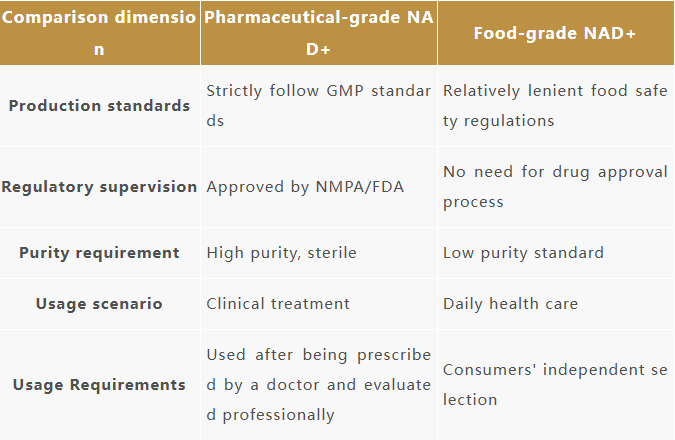
The consensus clearly states that food-grade NAD+ does not meet the requirements for intravenous infusion use.
For those with clear therapeutic purposes (such as improving heart function, assisting in chemotherapy, alleviating sarcopenia, etc.), they must use pharmaceutical-grade products under the guidance of a doctor and complete the treatment in a regular medical institution.
three far-reaching implications of consensus
1. Reaffirming legitimacy of medical intervention for age-related diseases
The occurrence and development of aging-related diseases are no longer a passive process that cannot be intervened; instead, they are an interventionable process with clear biological targets.
In the past, the relevant market was long dominated by conceptual hype.
The release of the consensus means that NAD+ has become the first intervention target to be systematically recognized by the authoritative academic organization of geriatric medicine in China and directly linked to aging-related diseases.
The doctors have gained authoritative evidence, and the public now has a nationally recognized consensus to refer to.
2. Provide a "quantifiable, monitorable, and intervenable" path for healthy aging
The consensus not only answers the questions of "what to use and how to use", but also builds a complete closed loop of "detection - intervention - management".
First, determine the NAD+ levels and functional status through testing.
Then, based on the individual's condition, select an appropriate intervention strategy. Finally, continuously monitor to optimize the effect.
This has changed the embarrassing situation where "the effectiveness of intervention could not be measured".
3. Promote standardized distinction between "pharmaceutical grade" and "food grade"
The release of the consensus will enable the market and regulatory authorities to more clearly distinguish the usage scenarios of the two types of products, guiding consumers to break away from the misconception that "identical product names mean identical effects", and avoiding blind consumption that leads to wasted money without achieving the expected results, and even causing health risks.
Prev: multiple mechanisms by which NMN affects weight
Next: Is NMN really effective? A comparison of three NAD+ supplements


