
Glutathione redox signaling and cell fate
The cellular antioxidant network is of vital importance for maintaining redox homeostasis, as it balances the inhibition of oxidative damage and the controlled transmission of redox signals that determine cell fate.
For a long time, glutathione (GSH) has been regarded as the most important natural antioxidant in cells.
It can eliminate reactive oxygen species, maintain redox homeostasis, participate in detoxification reactions, and protect proteins, lipids and DNA from oxidative damage.
However, recent studies on cell death have revealed that the function of glutathione goes far beyond the traditional definition of "antioxidant".
It not only participates in redox regulation, but also deeply intervenes in metabolic reprogramming, metal ion homeostasis, and the regulation of various forms of cell death.
Glutathione actually serves as a crucial link between metabolism and cell fate.
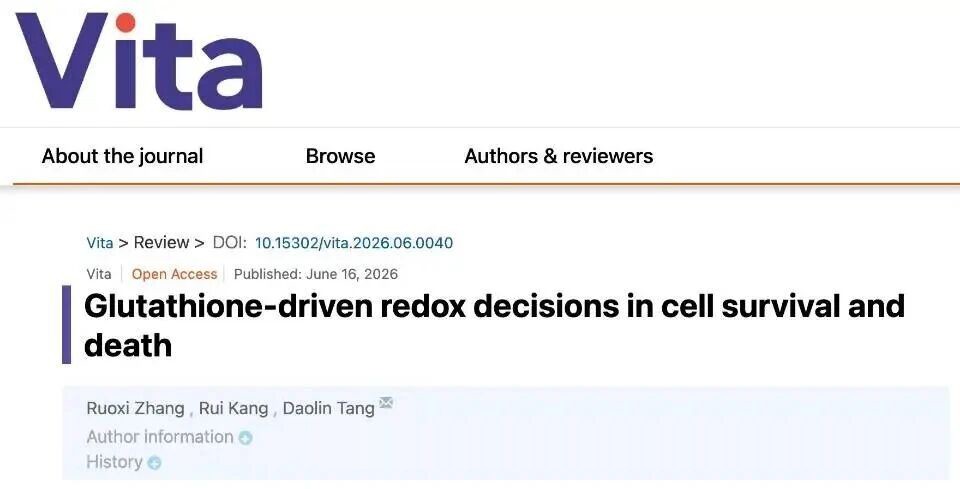
On June 16, 2026, the team led by Professor Tang Daolin from the University of Texas Southwestern Medical Center (with Dr. Zhang Ruoxi as the first author of the paper) published a review article titled "Glutathione-driven redox decisions in cell survival and death" in the Vita journal.
This article summarizes the regulatory role of glutathione (Glutathione, GSH) in cell survival and death, and proposes that GSH is not only a classic antioxidant molecule, but also an important hub that connects metabolic homeostasis, redox signals and cell fate determination.
The authors propose that glutathione (GSH) is not merely an antioxidant molecule, but rather a regulatory node for redox balance that determines cell survival and death.
Glutathione not only serves as the guardian of cellular integrity, but also acts as a determinant of cell death susceptibility and therapeutic vulnerability depending on specific circumstances.
By leveraging this dual characteristic, a theoretical framework has been established for identifying redox-related target defects and developing a new generation of therapies targeting metabolic and oxidative imbalances in cancer and other diseases.
As a metabolic component naturally present within human cells, glutathione (Glutathione, GSH) has been redefined in the current field of nutritional science as the benchmark indicator for assessing an individual's "cellular antioxidant capacity".
Unlike vitamin-based antioxidants which often act as "consumables for eliminating free radicals", glutathione plays the role of a "reduction power center" in the biochemical chain.
The core value lies in the fact that it constitutes a solid defense line for the endogenous antioxidant defense system within the human body, determining the repair efficiency and metabolic benchmark of cells when they are dealing with oxidative stress.
Original link:https://www.vita-journal.com/vita/EN/10.15302/vita.2026.06.0040
Related products


Related news
-
Can glutathione really be absorbed when taken orally?
2026-05-26 -
effect of glutathione on antioxidant capacity of corn seedling roots under salt stress
2026-06-02 -
Glutathione biomimetic coordination cage confined catalysis
2026-06-09 -
At age of 40, do you focus on nutrients such as glutathione?
2026-06-22
