
Glutathione biomimetic coordination cage confined catalysis
Research Background
Nitrogen oxides (NOₓ) are a key component of the global nitrogen cycle.
How to efficiently convert NOₓ into high-value nitrogen-containing chemicals (such as ammonia and amino acids) is not only an urgent need for environmental governance but also an important direction for resource recycling.
The solubility of NOₓ in the electrolyte is low and its stability is poor.
Moreover, during the electrocatalytic reduction process, it faces intense competition from the hydrogen evolution reaction (HER), which severely restricts the conversion efficiency and scalability.
Nature has already provided an elegant solution:
The natural S-nitrosoglutathione reductase achieves absolute selectivity and high efficiency in ammonia synthesis through glutathione-mediated NO binding, within an evolutionally optimized active pocket.
Inspired by this, researchers began to explore the use of coordination capsules - artificial catalysts with integrated active sites and secondary coordination environments - to simulate the catalytic behavior of enzymes in confined cavities.
Research content
In this study, the iron(II) coordination cage H1 (Fe₆L₄) was used as the core catalyst.
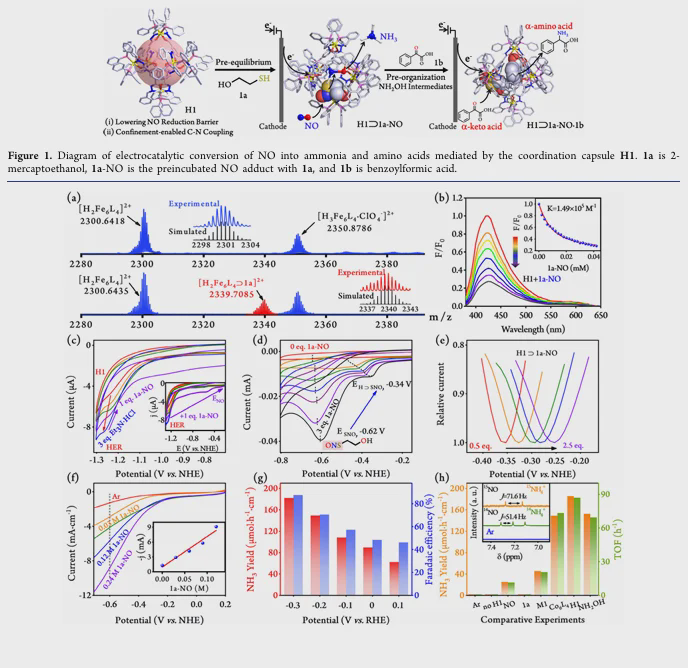
The glutathione analog - 2-mercaptobenzene (1a) was pre-reacted with NO to form S-nitroso adduct (1a-NO), which was then captured within the confined cavity of H1 to achieve efficient electrocatalytic reduction of NO.
The reaction follows the Michaelis-Menten enzyme kinetics mechanism: the reaction exhibits first-order kinetics with respect to H1 and a saturation behavior with respect to 1a-NO.
The enzyme constants are nearly consistent under different potentials, confirming the enzymatic catalytic pathway of substrate inclusion complex formation → N-O bond breakage → NH₃ release within the confined cavity.
The ATP competition inhibition experiment further confirmed the specific binding of the substrate within the cavity.
In the aspect of amino acid synthesis, the researchers introduced α-keto acids (such as benzoic methyl carboxylic acid 1b) and NO adducts simultaneously into the H1 cavity, thereby achieving the synthesis of C-N double bonds to form amino acids.
In situ Raman spectroscopy detected the NH₂OH intermediate and C-N vibration signals (at 593 and 1048 cm⁻¹), confirming the reaction pathway as:
NO is reduced to NH₂OH, which then directly couples with keto acids to form amino acids.
Work Innovation Points
1. Enzyme-like dual strategy integration:
For the first time, the two enzymatic mimicry strategies of "glutathione-mediated NO binding" and "coordination cage-limited catalysis" were combined organically.
In an artificial system, both the capture of the NO substrate and the enzyme-like activation were achieved simultaneously.
2. Precise regulation of confinement effect:
The H1 cavity (approximately 420 ų) not only provides a high substrate concentration, but its amide group also provides a hydrogen bond recognition site, enabling precise activation of NO adducts.
The oxidation potential shifts positively by up to ~1V, thermally inhibiting the hydrogen evolution competition.
3. Synthesis of amino acids by C-N coupling in one pot:
Simultaneously accommodating NO adducts and α-keto acids within the same confined cavity, the direct C-N coupling was achieved through the *NH₂OH intermediate, with a conversion efficiency (FE) of 55.2%.
This has opened up a new path for the high-value utilization of NOₓ.
Source of literature
Yao Wang, Meng Lv, Xu Jing, Jinfeng Wang, and Chunying Duan, Glutathione-Mediated Biomimetic NO Activation with Coordination Capsules for NH3 and α-Amino Acid Electrosynthesis, Journal of the American Chemical Society, DOI: 10.1021/jacs.6c01915, https://doi.org/10.1021/jacs.6c01915
Prev: effect of glutathione on antioxidant capacity of corn seedling roots under salt stress
Next: At age of 40, do you focus on nutrients such as glutathione?
Related products


Related news
-
Glutathione not only acts as an antioxidant, but also nourishes cancer cells
2026-04-28 -
A probe for visualizing glutathione levels in adipose tissue
2026-05-19 -
Can glutathione really be absorbed when taken orally?
2026-05-26 -
effect of glutathione on antioxidant capacity of corn seedling roots under salt stress
2026-06-02
