
Record of glutathione production by Saccharomyces cerevisiae
Glutathione (abbreviated as GSH), this "cell protector" composed of three amino acids, is quietly transforming the pharmaceutical, health supplement, and cosmetic industries.
997.46 mg/L!
This figure has broken the world record - the Li Yingjun team from Huazhong Agricultural University achieved the highest reported glutathione production in yeast through systematic metabolic engineering.
From an initial level of 74 mg/L to the current level of nearly 1 g/L, what kind of "magic" did they employ?
Why is glutathione so popular?
Glutathione is a tripeptide (γ-glutamyl-cysteine-glycine) that is widely present in living organisms and is known as the "antioxidant king" of cells:
Antioxidant: Eliminate free radicals and maintain the redox balance of cells.
Detoxification: Assist the liver in eliminating heavy metals and toxins.
Immune regulation: Regulate cell proliferation and apoptosis.
Whitening effect: Inhibit the activity of tyrosinase, becoming a star ingredient in skin care products.
With the sharp increase in market demand, traditional plant extraction and chemical synthesis methods have become unable to meet the requirements of industrial production.
Microbial synthesis, due to its strong scalability and controllable costs, has become a "new trend" in glutathione production.
Saccharomyces cerevisiae, as an industrial microorganism, possesses unique advantages:
GRAS Certification: High safety, recognized by FDA as a food-grade host
Good tolerance: Strong adaptability to the product and process conditions
Simple post-processing: Extracting the product can be achieved by simply cell disruption
The glutathione production of natural yeast is only about 74 mg/L, which is far from meeting the requirements for industrialization.
four-stage engineering paradigm: from "selecting right strain" to "precise regulation"
Li Yingjun's team employed a systematic metabolic engineering strategy, which can be regarded as a textbook-level "plant design guide".
Phase One: Host Selection - Identifying Naturally "High-yield Varieties"
The research team collected samples such as distillers' grains, vinegar residue, and vinegar yeast from all over the country.
They isolated and identified 31 strains of yeast, covering 24 different species.
The initial screening revealed that the glutathione content was relatively high in Saccharomyces cerevisiae, Kluyveromyces marxianus, and Candida utilis.
After a systematic shake-flask fermentation assessment, a strain named NJ-SQYY stood out:
Indicators
Yield: 74.14 mg/L
Cell content: 8.27 mg/g DCW
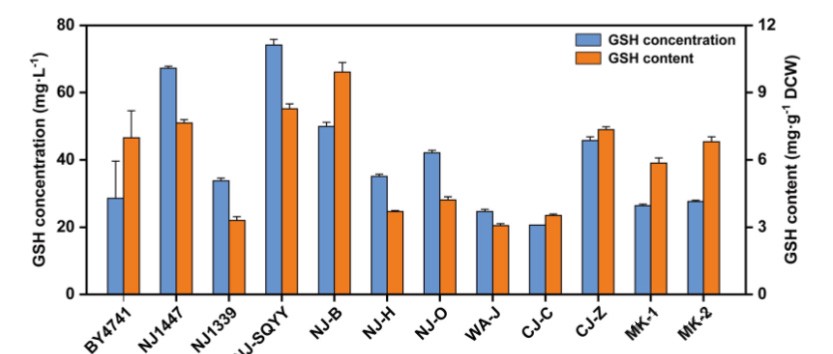
The figure shows the distribution of GSH production among 31 yeast strains.
This strain not only has high yield but also shows good cell growth conditions, making it an ideal starting point for subsequent engineering modifications.
Phase Two: Precise Integration with CRISPR/Cas9 - Introducing an "Efficient Enzyme" as an External Assistance
The natural yeast synthesizes glutathione through two steps, Gsh1 and Gsh2. However, this pathway has a feedback inhibition problem - the product will in turn inhibit the activity of the key enzymes.
The team innovatively introduced a bacterial-derived dual-function glutathione synthetase - GshAB.
This enzyme is derived from Actinobacillus pleuropneumoniae and is capable of catalyzing two reaction steps simultaneously, without being inhibited by the feedback of its products.
Using the CRISPR/Cas9 technology, the team precisely integrated the gshAB gene into the safe site (CS6 locus) of the yeast genome.
After eliminating the plasmid burden, the glutathione production of the engineered strain SQ1 reached 112.74 mg/L, which was 33.14% higher than that of the wild type.
Phase Three: Enzyme Engineering Optimization - Screening and Modification of "Super Enzymes"
Simply integrating just one gene is clearly not enough.
The team further carried out systematic optimization and screened GshAB homologous enzymes from 9 different bacterial species:
Lactobacillus (Lactic acid bacteria genus)
Enterococcus (Enterococcus genus)
Streptococcus (Streptococcus genus)
Clostridium (Clostridium genus)
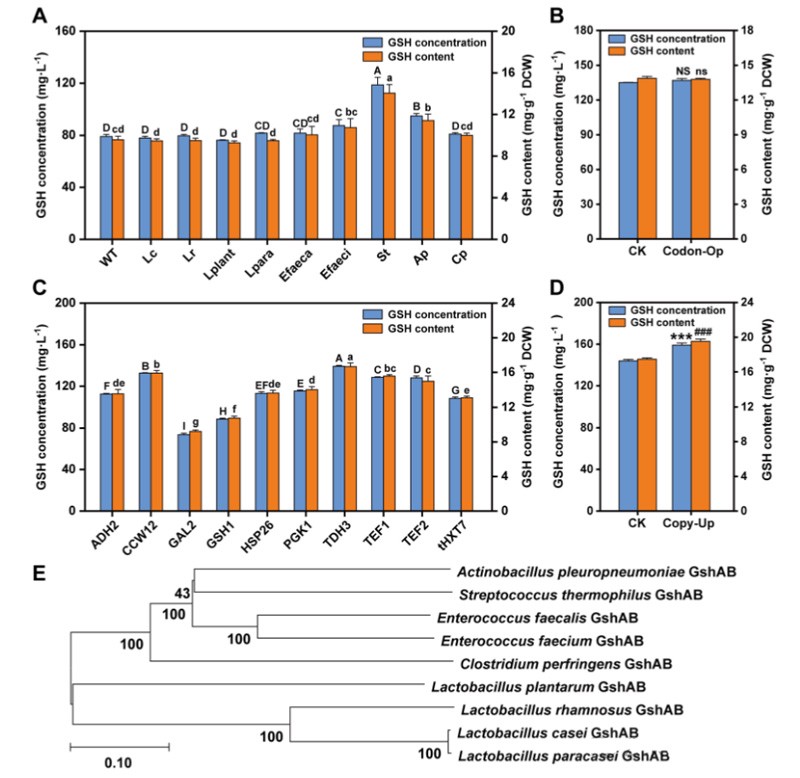
A) Comparison of the production levels of 9 types of bacteria GshAB;
B) The effect of codon optimization;
C) Expression levels of different promoters;
D) The effect of increasing gene copy number;
E) Phylogenetic analysis of GshAB protein
Key finding: The GshAB_St derived from Streptococcus thermophilus performed the best!
118.65 mg/L (an increase of 49.96%)
Codon optimization: No significant effect (indicating that the original codons were already compatible with the yeast tRNA library)
Promoter engineering: After using the PTDH3 strong promoter, the yield increased to 138.52 mg/L (another increase of 30.27%)
Gene copy number increase: Limited effect (exists a "ceiling effect")
Phase Four: Metabolic Network Reconstruction - Breaking Through "Last Mile"
Even if the exogenous pathways are optimized to the fullest extent, the endogenous metabolic bottleneck still exists.
The team adopted two key strategies:
Strategy 1: Gsh1-Gsh2 enzyme fusion
The yeast's own Gsh1 and Gsh2 were linked together using a flexible linker peptide [(Gly-Gly-Gly-Gly-Ser)₃] to form a bifunctional fusion enzyme called GLG.
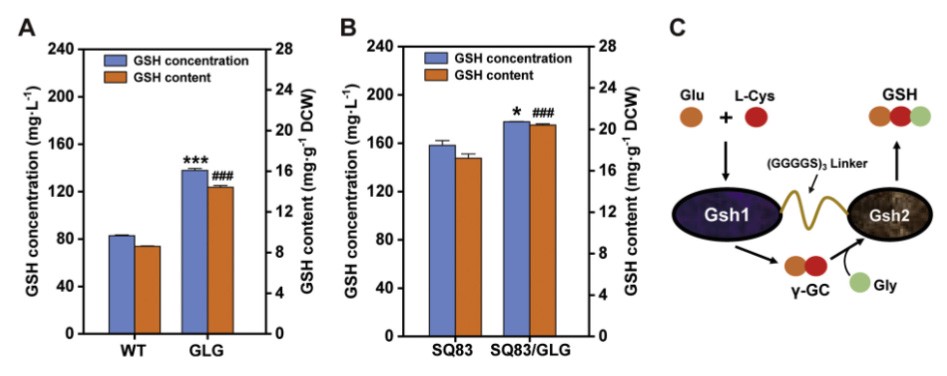
C) Illustration of the fused protein structure;
(A-B) Comparison of production volumes before and after integration
Amazing effect:
Integrated into the wild type: Yield increased by 66.63%, cell content increased by 67.40%
Integrated into the engineering strain SQ83: The yield reached 177.76 mg/L
Strategy 2: Overexpression of CYS3 - Removing the Cysteine Bottleneck
Cysteine (L-cysteine) is a crucial precursor for the synthesis of glutathione.
The team conducted a systematic analysis of the precursor synthesis pathway and discovered that CYS3 (cystathionine γ-lyase) is the key rate-limiting enzyme.
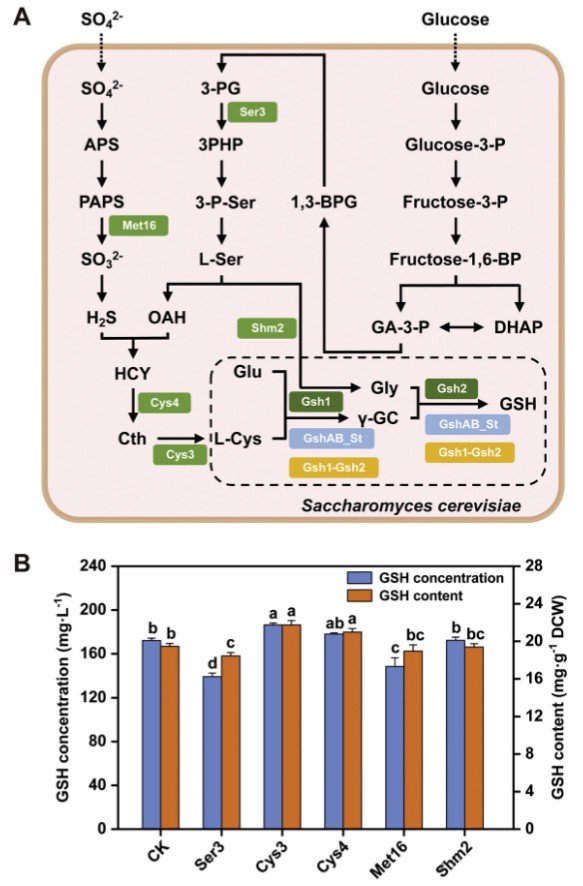
A) GSH biosynthesis metabolic network;
B) Effects of overexpression of genes in different precursor pathways
After overexpression of CYS3, the yield of strain SQ842 reached 186.45 mg/L, and the cysteine metabolic flux was significantly enhanced.
Industrialization expansion: "dangerous leap" from shake flasks to fermentation tanks
No matter how impressive the shake-flask data is, if it cannot be mass-produced, it is just "empty talk on paper".
The team conducted batch-fed fermentation in 5-liter fermentation tanks using the optimal strains SQ84 and SQ842. The results were extremely encouraging:
SQ842: High cell density, no exogenous cysteine; 784.85 mg/L; 25.37 mg/g dry cell weight;
SQ84: Add 2 g/L cysteine; 997.46 mg/L; 33.85 mg/g dry cell weight;
value of failure cases: Why did GroEL/ES and YAP1 "fail"?
What makes this paper most worthy of attention is not just the successes, but also the "unsuccessful" attempts - these lessons are equally valuable.
GroEL/ES molecular chaperone: Helpful or Harmful?The GshAB of prokaryotes may have folding problems in eukaryotic host yeast.
Theoretically, introducing the GroEL/ES chaperone system from Escherichia coli should be able to improve protein folding.
Actual result:
intracellular glutathione did increase
However, the biomass dropped significantly
Ultimately, the total yield decreased as well
Reason analysis: The bacterial companion system has difficulty performing its best function in the oxidative-reductive environment of yeast, instead increasing the metabolic burden on the cells.
YAP1 Transcription Factor: Why the "Antioxidant Star" Is "Sputtering"?
YAP1 is the "antioxidant master switch" in yeast.
Theoretically, overexpression should activate the genes for glutathione synthesis.
Actual result:
Under normal culture conditions, overexpression of YAP1 failed to increase yield.
Under oxidative stress (H₂O₂ treatment), YAP1 did activate the defense response.
However, the glutathione level did not show significant changes.
Reason analysis: Under normal culture conditions, YAP1 is in a quiescent state; simply overexpressing YAP1 cannot continuously activate downstream genes.
Insight: Metabolic engineering cannot be taken for granted - every "common sense" requires experimental verification.
References
[1] Hu Z, Su M, Liu Q, et al. Systems metabolic engineering of glutathione biosynthesis in Saccharomyces cerevisiae: Pathway balancing coupled with enzyme screening for high-titer production. Engineering Microbiology, 2025, 5: 100243. https://doi.org/10.1016/j.engmic.2025.100243
Prev: Glutathione - King of Antioxidants and Cell Guardian Code
Next: Glutathione not only acts as an antioxidant, but also nourishes cancer cells


