
Glutathione and Antioxidant System
Cells have a sophisticated antioxidant defense system.
And at the core of this system is a small molecule called glutathione.
Think of glutathione as the "cleaner" of the cell - specifically, it removes the "garbage" of free radicals.
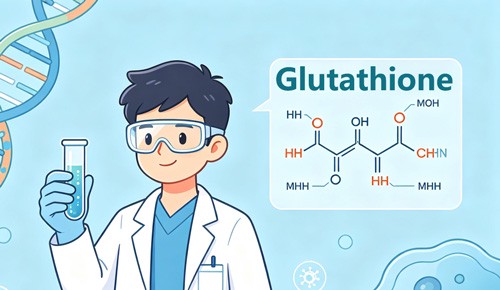
Who is glutathione?
Glutathione is a small molecule tripeptide composed of three amino acids: glutamic acid, cysteine, and glycine.
Glutathione exists in almost every cell of the human body.
It can be found in the blood, the liver, the eyes, and even in your red blood cells.
The reason why glutathione can act as a "cleaner" is due to a key part of its structure - the sulfhydryl group (-SH).
Imagine the sulfhydryl group as a "powerful scrubber".
When free radicals come, glutathione uses this scrubber to "clean" them - neutralizing the free radicals and transforming itself from a "clean scrubber" (reduced form, abbreviated as GSH) to a "dirty scrubber" (oxidized form, abbreviated as GSSG).
But it doesn't do this once and for all.
There are specialized "cleaning machines" in cells - glutathione reductase - that can wash the "dirty scrubber" back to the "clean scrubber", allowing for recycling.
When a glutathione molecule is oxidized, it can be "cleansed" by the reductase and return to work, cycling through the process.
Three Lines of Defense: "Antioxidant Army" of Cells
Glutathione is not a single person fighting alone.
Cells have three lines of antioxidant defense.
1. "regular army" of antioxidant enzymes
This is the fastest defense force of the cell.
Among them, the most important one is superoxide dismutase (SOD), which is responsible for converting superoxide free radicals into hydrogen peroxide.
Then glutathione peroxidase (GPx) takes over, converting hydrogen peroxide into harmless water.
They work in tandem to complete the clearance - one for "pre-treatment" and the other for "complete removal".
GPx requires selenium to function - people lacking selenium will have greatly reduced effectiveness of this "regular army".
2. Small Molecule "Death Squad"
Glutathione is the main force of this defense line.
It rushes straight in and "collapses" with free radicals - itself becomes dirty and neutralizes the free radicals.
Vitamin C and Vitamin E are also members of this defense line.
They work together with glutathione - Vitamin C helps glutathione "return to duty", and Vitamin E protects the cell membrane.
3. Repair and Recycling "Logistics Team"
What about the damages that have already been caused but were not stopped by the first two lines of defense?
Cells also have a "repair team".
It can repair oxidized proteins.
If it can't repair them, it directly sends them to the proteasome for degradation and recycling.
The three lines of defense cooperate to block every step from the "generation" of free radicals to the "causing damage".
How extensive is "inventory" of glutathione?
The glutathione in cells is not infinitely available.
It has a "stock indicator" - the ratio of reduced glutathione (GSH) to oxidized glutathione (GSSG).
Under normal physiological conditions, the ratio of reduced GSH to oxidized GSSG is usually maintained at above 100:1, and in resting cells, it can even exceed 1000:1.
This means that the vast majority of glutathione in the cell is like a "cleaning cloth", ready to be used at any time.
However, this "stockpile" will thin out as one ages.
Studies have shown that the level of glutathione decreases with age.
And healthy and long-lived elderly people often have higher levels of glutathione in their bodies.
The quantity and quality of your "cleaning workers" directly affect how quickly you age.
How to keep your "cleaning agent" in good condition?
Glutathione is synthesized by the cells themselves and is not "consumed" directly from food.
However, it can be provided with "raw materials" and "support" through diet.
1. Consume at least three types of ingredients
Glutathione is composed of glutamic acid, cysteine, and glycine.
Among them, cysteine is the "limiting raw material" - its supply directly determines the synthesis speed of glutathione.
Foods rich in cysteine: chicken, turkey, eggs, yogurt, cheese, sunflower seeds, beans.
Glutamic acid and glycine have a wider source: dairy products, beans, nuts, seeds.
2. Add key "auxiliary factors"
The synthesis and circulation of glutathione require the participation of nutrients such as selenium, vitamin B6, and magnesium.
Selenium: The "core component" of glutathione peroxidase.
Brazil nuts (one per day is sufficient), seafood, mushrooms, eggs
Vitamin B6: Whole grains, meats, bananas
Magnesium: Dark green leafy vegetables, nuts, whole grains
3. Consume foods rich in glutathione precursors
Although the glutathione consumed directly will be digested and decomposed, foods rich in its precursors - asparagus, avocados, spinach, okra, and broccoli - can help replenish it.
4. Vitamin C and E are "good partners"
Vitamin C can convert "dirty rags" (GSSG) into "clean rags" (GSH), helping the glutathione cycle and recycling.
Vitamin E works in tandem with glutathione to protect cell membranes.
Citrus fruits, kiwis, deep green vegetables (vitamin C); nuts, seeds (vitamin E).
References:
1. Glutathione is a tripeptide containing a γ-amino group and a thiol group, composed of glutamic acid, cysteine and glycine. SciTech China, 2018.
2. Glutathione exists in almost every cell of the body. SciTech China, 2018.
3. The ratio of GSH/GSSG exceeds 1000:1 in resting cells, and is usually maintained above 100:1 under normal physiological conditions. PMC.
4. Glutathione is the most important and abundantly present small molecule detoxifier within cells. PMC, 2015.
5. Glutathione peroxidase (GPx) is an important selenium-containing antioxidant enzyme. Wanfang Medical, 2021.
6. Cysteine is the limiting raw material for the synthesis of glutathione. PubMed Review, 2023.
7. Vitamins B6, magnesium and selenium can enhance the synthesis of endogenous glutathione. PubMed, 2015.
8. Glutathione levels decline with age. PubMed Review, 2023.
9. The antioxidant defense system is a multi-layer defense mechanism within the cell, composed of antioxidant enzymes and small molecules such as glutathione. Bohrium.
10. Vitamin C can reduce oxidized glutathione to reduced glutathione. biomart.
11. Glutathione peroxidase and superoxide dismutase work in tandem to eliminate reactive oxygen species and protect cells from oxidative damage. Advances in Life Sciences, 2020.
Prev: How should SOD, MDA, glutathione and antioxidant pathways be combined?
Next: Glutathione triggers reassembly and amplification of NIR-II photothermal effect


