
molecular regulatory mechanism of exogenous glutathione in alleviating cadmium stress in alfalfa
Guide
Cadmium pollution in soil and water bodies has been exacerbated by industrial activities and the excessive use of cadmium-containing phosphorus fertilizers, posing a serious threat to crop growth.
Glutathione, as a key antioxidant, is widely used by plants to maintain reactive oxygen species homeostasis under abbiotic stress, including cadmium stress, but its molecular mechanism in alfalfa remains unclear.
This study systematically revealed the mechanism by which glutathione alleviates cadmium stress in alfalfa by integrating transcriptomics, metabolomics, growth and physiological indicators.
The results showed that cadmium stress significantly inhibited the growth of alfalfa, while exogenous glutathione treatment could partially restore its growth trend, specifically manifested as an increase in fresh weight and plant height.
Glutathione reduces oxidative damage markers (malondialdehyde content, superoxide anion level) and enhances antioxidant defense capabilities (glutathione content, superoxide dismutase activity, peroxidase activity, total antioxidant capacity).
Multi-omics analysis indicates that glutathione alleviates cadmium stress by enhancing the expression of genes related to plant hormone signal transduction pathways and the accumulation of metabolites.
Glutathione activates the biosynthesis of amino acids and soluble sugars, significantly increasing the levels of tryptophan and rhamnose, and simultaneously upregulates the expression of genes such as acetylserotonin oxymethyltransferase, proline dehydrogenase, and trehalose 6-phosphatase, thereby enhancing the reactive oxygen species clearance capacity and osmotic regulation function.
Glutathione upreregulates the expression of lignin synthesis pathway genes to enhance the cell wall's barrier effect against cadmium, and restricts the transport of cadmium ions to the aboveground by promoting the expression of metal exhalation protein genes, thereby reducing toxic effects.
This study analyzed a new mechanism of cadmium tolerance in alfalfa mediated by glutathione at the molecular level, providing an important theoretical basis for breeding cadmium-tolerant varieties and promoting sustainable agricultural development.
Research Highlights
(1) Cadmium stress inhibits plant growth by enhancing oxidative stress, while exogenous glutathione can effectively reverse this growth inhibition.
(2) Glutathione reduces the transport and absorption of cadmium by inhibiting the expression of metal transporters YSL, NRAMP and HMA.
(3) Glutathione alleviates cadmium stress-induced oxidative stress by activating the tryptophan metabolic pathway and the glutathione metabolic pathway.
Result
In this study, WL440 alfalfa was used as the material. The seeds were disinfected and germinated in a 25℃ light incubator.
Seven days later, the seedlings were transferred to 1/2 Hogland nutrient solution for hydroponics. After two months of cultivation, three treatments were set up: control (CK), cadmium stress (Cd, 20 μM CdCl₂), and cadmium stress + glutathione (CdGSH, 20 μM CdCl₂+200 μM GSH), with a treatment period of two weeks.
The experiment evaluated physiological indicators such as plant height, root length and biomass. The cadmium content in tissues was determined by ICP-MS, and biochemical parameters such as SOD, POD, GSH and MDA were determined by reagent kits.
Integrate transcriptome, metabolome and WGCNA analyses to screen differential genes and metabolites, and verify key genes using RT-qPCR.
(1) effect of glutathione on growth of alfalfa under cadmium stress
Under cadmium stress conditions, the growth of alfalfa seedlings was significantly inhibited, while the supplementation of exogenous glutathione effectively alleviated the adverse effects of cadmium stress (Figure 1A).
Compared with the control group (aboveground control SCK, root control RCK), the fresh weight of the aboveground and root in the cadmium treatment group (SCd, RCd) decreased by 63% and 67% respectively (Figure 1B-C), and their plant height and main root length also decreased by 63.78% and 52.82% respectively (Figure 1D-E).
In contrast, the abovematic fresh weight and root fresh weight of the CdGSH treatment group (SCdGSH, RCdGSH) increased by 108.3% and 189.18% respectively compared with the cadmium treatment group (Figure 1B-C), and the plant height and main root length increased by 114.86% and 41.09% respectively (Figure 1D-E).
The results of cadmium content determination showed that compared with the control group, cadmium treatment led to a significant increase in cadmium content in various tissues of alfalfa (Figure 1F-G);
After the addition of glutathione, the cadmium content in RCdGSH was significantly higher than that in RCd, while the cadmium content in SCdGSH was 87.85% lower than that in SCd (Figure 1F).
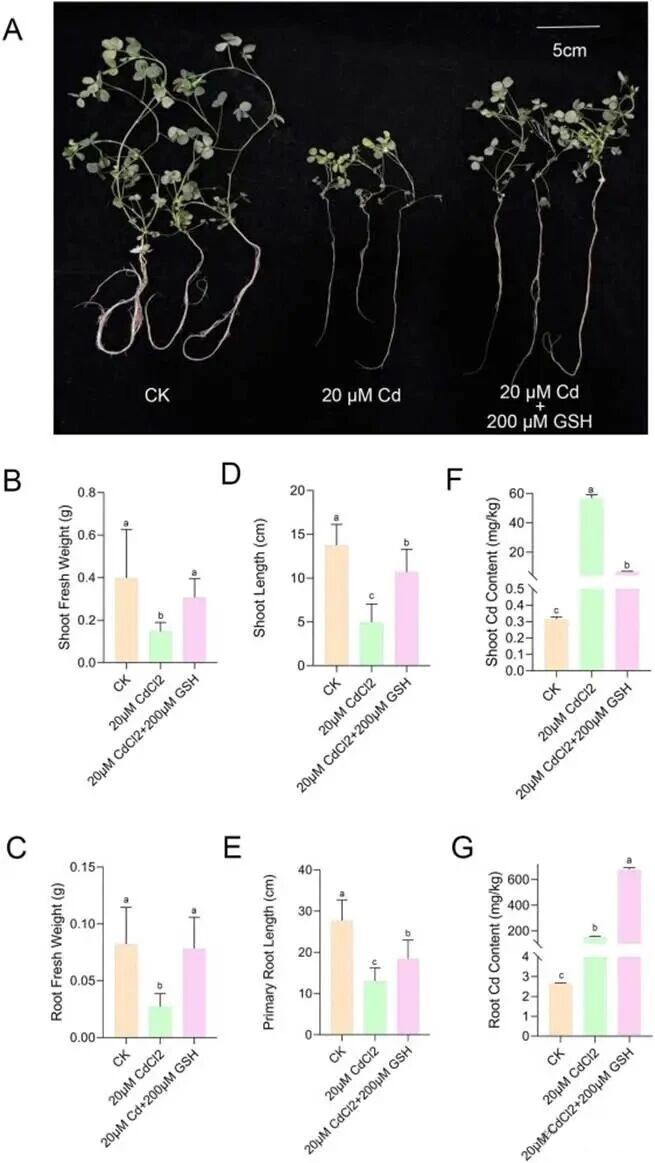
Figure 1 Phenotypic data determination. Glutathione alleviated the inhibitory effect of cadmium stress on the fresh weight and plant height of alfalfa. (A) Phenotype of alfalfa seedlings (with a scale of 5 cm). CK represents seedlings without stress, Cd represents seedlings treated with 20 μM CdCl₂, and CdGSH represents seedlings treated with both 20 μM CdCl₂ and 200 μM GSH simultaneously. (B) Fresh weight of the above-ground part; (C) Fresh and heavy roots; (D) Plant height; (E) Main root length; (F) Cadmium content in the aboveground part; (G) Cadmium content in the roots.
(2) Oxidative damage and antioxidant enzyme system
Under CdCl₂ stress, the content of superoxide anion, glutathione, total antioxidant capacity and superoxide dismutase activity in the aboveground part and roots of alfalfa seedlings all significantly increased, and the peroxidase activity in the roots also significantly improved.
However, after the combined administration of glutathione and CdCl₂, most indicators showed a significant decrease.
The activities of superoxide dismutase in the aboveground parts and roots decreased by 72% and 61.93% respectively.
The peroxidase activities decreased by 17.67% and 85.33% respectively.
The glutathione content decreased by 41.49% and 42.03% respectively.
The total antioxidant capacity decreased by 8.28% and 13.73% respectively.
The content of superoxide anion decreased by 51.69% and 33.95% respectively.
The content of malondialdehyde decreased significantly by 20.34% and 64.18% respectively.
DAB staining and NBT staining were performed on the above-ground and root samples of the three treatment groups respectively.
The staining results indicated that the accumulation of reactive oxygen species was the most significant in the cadmium treatment group, followed by the CdGSH group, while the accumulation of reactive oxygen species was the lowest in the control group.
(3) Comparative analysis of Alfalfa transcriptome
Principal component analysis showed significant separation among different treatment groups and good biological reproducibility, indicating high sample reliability.
By comparing the differentially expressed genes in different gene sets (SCd vs. SCK, SCdGSH vs. SCd, RCd vs. RCK, RCdGSH vs. RCD), the results showed that compared with the control group, there were 1074 up-regulated genes and 1696 down-regulated genes in the aboveground part. There are 981 up-regulated genes and 777 down-regulated genes in the root.
Compared with cadmium treatment alone, the addition of exogenous GSH led to the production of 133 differentially expressed genes (84 up-regulated and 49 down-regulated) in the above-ground parts and 869 differentially expressed genes (348 up-regulated and 521 down-regulated) in the roots (see Figure S4A).
The Venn diagram shows the shared and unique differentially expressed genes among various gene sets.
Analysis revealed that there were 69 differentially expressed genes specific to the above-ground SCdGSH and 2,706 specific to the SCd.
There are 566 differentially expressed genes specific to RCdGSH and 1455 specific to RCd in the root.
It is worth noting that there are 64 co-expressed differential genes in the aboveground part and 303 co-expressed differential genes in the root.
At the same time, cluster analysis of expression patterns was conducted on all differentially expressed genes, and heat maps of above-ground and root clusters were drawn to demonstrate the regulatory characteristics of each treatment.
(4) Comparative analysis of metabolome of alfalfa
Based on the sequencing results of metabolites, it was found that compared with the control group, 1,205 differential metabolites were identified in the above-ground parts and 1,609 in the roots of the cadmium treatment group.
A total of 701 differential metabolites were detected in the SCdGSH and SCd comparison groups, while 1,182 were identified in the RCdGSH and RCd comparison groups.
Further analysis revealed that there were 287 overlapping differential metabolites in the aboveground part and 730 overlapping differential metabolites in the roots.
Subsequently, we conducted cluster analysis on all the differential metabolites and drew a cluster heat map to visually display the changing trends of the differential metabolites in the aboveground and root treatment groups.
(5) Combined analysis of transcriptome and metabolome
To explore the association between the transcriptome and metabolome under cadmium stress, we conducted a nine-quadrant analysis.
The results showed that in the comparison between cadmium treatment and the control group, the number of differentially expressed genes and differentially expressed metabolites showing the same trend was relatively large, while in the comparison group between CdGSH and Cd, it was relatively small.
Subsequently, we conducted a joint analysis of the pathways that were significantly enriched in both the gene set (P<0.05) and the metabolic set (P<0.05), and drew a KEGG pathway enrichment bubble chart.
It was found that four pathways were co-enriched in the SCd and SCK comparison groups, mainly including phenylpropane biosynthesis, flavonoid biosynthesis and the biosynthesis of various plant secondary metabolites.
Only the tryptophan metabolic pathway was enriched in the SCdGSH and SCd comparison groups.
In root tissues, a total of 9 pathways were co-enriched in the RCd and RCK comparison groups, covering pathways such as plant hormone signal transduction, glutathione metabolism, flavonoid biosynthesis, and arginine, aspartic acid, and glutamic acid metabolism.
Compared with RCd, the RCdGSH comparison group was enriched in a total of 10 pathways, mainly including phenylpropane biosynthesis, flavonoid biosynthesis, ABC transporter, isoflavone biosynthesis and arginine biosynthesis.
Under cadmium stress, the biosynthesis of various secondary metabolites (especially phenylpropanes and flavonoids) shows a synergistic regulation at both the transcriptome and metabolome levels.
It is worth noting that the underground part is also enriched with pathways such as plant hormone signal transduction, ABC transporters, and various amino acid metabolism.
(6) Analysis of gene co-expression networks
The response of alfalfa to cadmium stress involves a complex multi-gene regulatory network.
In this study, through transcriptome analysis of alfalfa seedlings in three treatment groups, more than 10,000 differentially expressed genes were identified.
Weighted gene co-expression network analysis (WGCNA) was used to conduct association analysis between these differentially expressed genes and cadmium stress-related phenotypes, and ultimately four significant co-expression modules were identified.
The correlation analysis between the module and the phenotype indicated that the total antioxidant capacity and malondialdehyde content in the blue module were strongly positively correlated with the gene expression level (correlation coefficient r=0.86-0.901), suggesting that the genes in this module might be involved in the antioxidant mechanism and the process of reactive oxygen species clearance.
In the cyan green module, the plant length-related phenotype was significantly positively correlated with the gene expression level (r=0.49).
The gene expression level in the blue module was significantly positively correlated with fresh weight (r=0.602), indicating that the genes in this module may play a key role in glutathione-mediated cadmium tolerance.
The blue module contains 5,802 differential genes, and the cyan module contains 7,359 differential genes.
Based on connectivity, the top 30 genes are selected as the key hub genes of these two modules, representing the core functions of the corresponding modules.
Subsequently, these core genes were visualized through CytoScape software (version 3.9.1), highlighting their significant roles in the regulation of flavonoid biosynthesis pathways, flavonoid methylation modification, carbohydrate transport, photosystem, glutathione metabolic pathways, and stress response.
(7) Verification of RNA-seq results by qRT-PCR
The relative expression levels of eight genes in the aboveground and root parts were verified respectively by qRT-PCR technology.
The eight genes selected in the aboveground part are mainly involved in isoflavone biosynthesis, pathogen infection response, gibberellin biosynthesis, MAPK signal transduction, flavonoid biosynthesis, ethylene signal transduction, proline degradation and abolic acid signal transduction.
The eight genes selected from the root are mainly associated with isoflavone biosynthesis, pathogen infection response, gibberellin biosynthesis, MAPK signal transduction, flavonoid biosynthesis, ethylene signal transduction, proline degradation and abolic acid signal transduction.
To verify the reliability of transcriptome data, by calculating the linear regression coefficient between RNA-seq data (log2FC) and qRT-PCR results (ΔΔCt method), it was found that there was a strong positive correlation (R²>0.6) between the two methods, confirming the reliability of the transcriptome results.
These findings suggest that the dataset can be used for subsequent transcriptome analysis.
Conclusion
Cadmium, as a highly toxic heavy metal, will significantly hinder the growth and development of plants after being absorbed.
This study systematically clarified the mechanism by which glutathione mediates cadmium tolerance in alfalfa through the integration of transcriptome and metabolome analyses.
Glutathione increases the expression levels of APX, DHAR and G6PD in the ascorbic acid-glutathione cycle, raises the glutathione content in tissues, promotes the glutathione chelation of cadmium ions in the cytoplasm, and enhances the ability to clear reactive oxygen species.
Glutathione can induce the expression of metal transporters, mediate the transport of cadmium ions or Cd-GS2 complexes to vacuoles, and simultaneously upregulate the gene expression of metal efflorescence proteins, thereby reducing the accumulation of cadmium in tissues.
Glutathione promotes the accumulation of soluble sugars and melatonin in tissues by activating the expression of otsB and ASMT genes.
Through comprehensive physiological and biochemical, transcriptomic and metabolomics studies, this research indicates that glutathione alleviates cadmium toxicity by fundamentally altering gene expression and activating multiple molecular defense mechanisms under cadmium stress.
These findings provide an important theoretical basis for the cultivation of cadmium-tolerant plant varieties.
Source: DOI: 10.1016 / j.i ndcrop. 2025.122254
Prev: What is safety of S-acetylglutathione in food dietary supplements?
Next: Glutathione is key antioxidant that unlocks anti-aging code
Related products


Related news
-
What is safety of S-acetylglutathione in food dietary supplements?
2025-11-11 -
What is supplements glutathione?
2025-10-28 -
Modified yeast efficiently synthesizes glutathione
2025-09-29 -
Glutathione is guardian of thyroid health
2025-07-17 -
Recovery of heavy metals and selenium: a key role for glutathione
2024-11-28 -
Glutathione is key antioxidant that unlocks anti-aging code
2025-11-25 -
Glutathione: A key molecule from biochemistry to anti-aging
2025-12-02 -
How to take glutathione for whitening to effective
2025-12-09 -
Unveiling Anti-aging Code of glutathione
2025-12-16 -
Liposomal glutathione: Cell-level antioxidant support
2025-12-30
