
What is safety of S-acetylglutathione in food dietary supplements?
Review development and application of glutathione (GSH)
Glutathione was discovered by the British biochemist Hopkins in 1921.
Over the course of more than 100 years of research and development, research on glutathione has won five Nobel Prizes and published nearly 200,000 + papers.
Glutathione, as an endogenous small molecule peptide in the human body, is now widely used in many fields such as medicine, health products, cosmetics and food.
In the 1990s, foreign glutathione drugs were introduced to China, promoting the application of glutathione in the domestic market. Glutathione has been recommended for use in numerous clinical guidelines such as the Guidelines for the prevention and Treatment of drug-induced Liver injury, the Guidelines for the prevention and Treatment of alcoholic liver Disease, the guidelines for the prevention and treatment of non-alcoholic liver disease, the diagnosis and treatment standards for primary liver cancer, and the guidelines for the diagnosis and treatment of chloasma, fully verifying the safety and efficacy of glutathione.
S-acetylglutathione (SAG), as a new type of antioxidant "dark horse", has excellent high stability, high absorption and safety after acetylation, making it an preferred alternative to supplement the GSH level in the body.
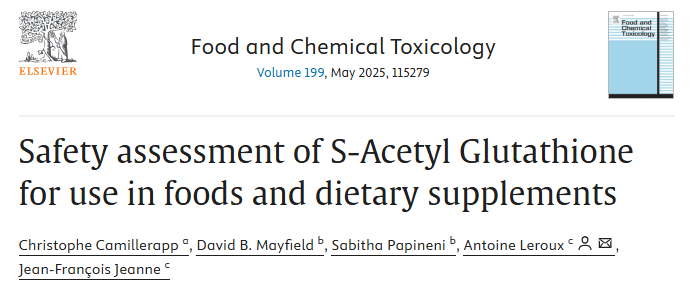
Abstract
S-acetylglutathione (SAG) is a glutathione precursor in a bioavailable form, used to supplement or maintain the level of glutathione (GSH) in circulation.
Glutathione is a powerful antioxidant that is crucial for resisting oxidative stress and is a key factor in many physiological functions.
To evaluate the safety of acetyl glutathione supplements, in vitro bacterial reverse mutation tests, in vitro micronucleus tests, acute oral toxicity studies and repeated-dose (13 weeks) toxicity studies were conducted.
No genotoxicity or mutagenic activity was found in in vitro tests.
In acute oral toxicity studies, no death or disease was observed (median lethal dose > 2000 mg/kg).
During the 13-week administration of acetylglutathione, the patient demonstrated good tolerance, with no neurobehavioral changes or effects on exercise activities, ophthalmic examination, hematology, coagulation function, blood biochemistry, urine analysis, thyroid hormone levels, or the male reproductive system.
There was a slight increase in the weight of the liver, kidneys and spleen, but these changes did not constitute adverse reactions. Within the historical control range, no macroscopic or histopathological abnormalities related to treatment were found in all organs.
The determined no-observed-adverse-effect level (NOAEL) is 1500 milligrams per day, which is the maximum test dose.
The results of these toxicological studies support the safe use of acetylglutathione in food or dietary supplements.
literature mentions:
A clinical study sponsored by Gnosis by Lesaffre compared the bioavailability of acetyl glutathione with a commercially available glutathione product. The study was conducted in a single-center, single-dose, randomized, open-label, two-sequence, two-phase crossover design clinical trial (Fanelli et al., 2018).
A total of 18 healthy volunteers received a single dose, among whom 9 received glutathione (3.5 grams) and 9 received acetylglutathione (3.494 grams).
After oral administration, the absorption rate (C max) and absorption range (AUC 0-t) of glutathione (GSH) in plasma after a single administration of acetylglutathione were significantly higher than those of the reference glutathione product.
In red blood cells, these parameters were slightly higher after a single administration of glutathione, but still significantly higher than those of acetylglutathione.
After a single administration of acetylglutathione and the reference glutathione products, the levels of glutathione-related dipeptide-cysteine-glycine (Cys-Gly) and γ -glutamylcysteine (γ -glucys) in plasma were compared. At the same dose, no significant differences were shown between the two preparations.
No treatment-related emergency adverse events occurred during the study period.
Conclusion
In vitro and in vivo toxicity studies were conducted to support a comprehensive safety assessment of S-acetylglutathione (SAG).
Genotoxicity, acute toxicity and repeated-dose toxicity were evaluated in accordance with regulatory requirements using the OECD testing guidelines.
In vitro experiments, no genotoxicity or mutagenic activity was detected up to the maximum recommended concentration.
Acute oral toxicity studies (median lethal dose > 2000 mg/ kg) did not identify treatment-related deaths, diseases or clinical symptoms, and acetylglutathione did not cause any adverse reactions in the 13-week repeated-dose toxicity study in rats.
The unobserved effector dose from the 13-week study was 1500 mg/kg/ day.
Other non-clinical research results in public literature are consistent with this, indicating that acetyl glutathione or GSH treatment did not show toxicity under different species and administration routes.
Clinical studies have also shown that after supplementing with acetylglutathione or GSH at different oral doses, there are almost no or only mild side effects (such as gastrointestinal discomfort).
Based on this safety assessment, given the current scientific knowledge and available toxicological research data, it is considered safe to use acetylglutathione in food and dietary supplements.
Reference: ScienceDirect, Food and Chemical Toxicology, Vol. 199 (2025)
Prev: What is supplements glutathione?
Next: molecular regulatory mechanism of exogenous glutathione in alleviating cadmium stress in alfalfa
Related products


Related news
-
What is supplements glutathione?
2025-10-28 -
Modified yeast efficiently synthesizes glutathione
2025-09-29 -
Glutathione is guardian of thyroid health
2025-07-17 -
Recovery of heavy metals and selenium: a key role for glutathione
2024-11-28 -
Research status of glutathione
2024-11-18 -
molecular regulatory mechanism of exogenous glutathione in alleviating cadmium stress in alfalfa
2025-11-18 -
Glutathione is key antioxidant that unlocks anti-aging code
2025-11-25 -
Glutathione: A key molecule from biochemistry to anti-aging
2025-12-02 -
How to take glutathione for whitening to effective
2025-12-09 -
Unveiling Anti-aging Code of glutathione
2025-12-16
