
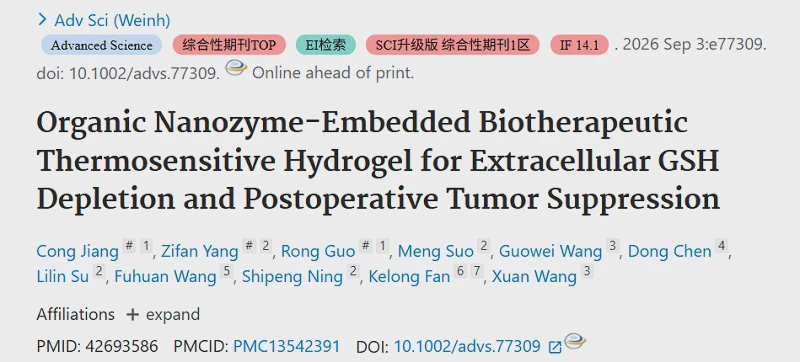
Bacterial thermosensitive hydrogel synergistically depletes extracellular glutathione to inhibit postoperative tumor recurrence
Huazhong University of Science and Technology Wang Xuan / Chinese Academy of Sciences Fan Kelong / Guangxi Medical University Ning Zhipeng Adv Sci (Weinh) | Light-controlled organic nanoenzyme - Bacterial thermosensitive hydrogel synergistically depletes extracellular glutathione to inhibit postoperative tumor recurrence
Research content
Postoperative recurrence of solid tumors is a major cause of clinical treatment failure.
The core problem lies in the residual micro-diseases in the tumor bed after surgery, the immunosuppression of the tumor microenvironment, and the abnormal enrichment of extracellular glutathione.
The traditional view mostly emphasizes the antioxidant effect of intracellular glutathione, but recent evidence suggests that extracellular glutathione in tumor stroma fluid can serve as a reserve of cysteine, which is released as cysteine through GGT1, supporting tumor protein synthesis, proliferation, maintenance of stemness and drug resistance;
At the same time, it also clears treatment-induced ROS, weakens the immunogenic cell death signal, enhances mTOR-related invasion and metastasis, and inhibits the function of infiltrating immune cells.
Bacterial-derived PAMPs can activate innate and adaptive immunity, but intravenous administration has the risks of systemic infection and inflammatory storm.
How to safely release bacterial immune stimulants locally after surgery, continuously deplete extracellular glutathione, and synergistically kill with photothermal/photodynamic/catalytic oxidation in a controllable manner is a key scientific issue for inhibiting postoperative recurrence.
The author designed a temperature-sensitive SEH hydrogel that was injected into the postoperative tumor bed, integrating "fluorescein-based organic nanoenzymes + Escherichia coli biological therapy + thermosensitive agarose local controlled release" onto the same platform.
SQ-Fe self-assembles into approximately 100 nm SN nanoparticles through DSPE-PEG.
Theoretical calculations show that it has a HOMO/LUMO separation and a small singlet-triplet energy gap, with ΔEST of 0.628 eV, which is conducive to inter-system crossing under 660 nm light illumination to generate ROS;
Experimental results confirmed that SN has both photothermal therapy PTT, photodynamic therapy PDT, and peroxidase-like POD activities.
The photothermal conversion efficiency is 40.15%, and the Michaelis constant KM for H2O2 is 2.125 mM, indicating a high catalytic affinity.
SEH gels and remains in place at body temperature. Under 660 nm laser irradiation, it triggers the transformation of agarose gel into a sol through thermal heating, releasing SN and E. coli;
The synergistic effect of photothermal and photodynamic therapy kills residual tumor cells, while lysing E. coli and releasing PAMPs such as LPS and FliC.
The released nanoenzymes continuously generate ROS with PDT, amplifying oxidative stress and depleting extracellular glutathione, disrupting the redox balance of residual tumor cells.
In vitro experiments showed that SEH+L significantly induced ROS bursts, increased Annexin V/PI apoptosis, decreased mitochondrial membrane potential, downregulated GPX4, and caused mitochondrial shrinkage, all of which are characteristics of ferroptosis.
At the same time, it reduced intracellular glutathione and inhibited the activation of p-4E-BP1/p-S6K1/mTOR induced by glutathione, as well as Transwell invasion and long-term proliferation.
At the immunological level, SEH+L upregulated CRT exposure, HMGB1 release and ATP secretion, which are typical ICD signals, promoting BMDC maturation, TNF-α/IL-6/IL-1β secretion, M2 to M1 macrophage polarization, and increasing the proportion of CD8+GZMB+ cytotoxic T cells in co-culture.
In the models of bilateral tumor, postoperative recurrence and lung metastasis, SEH+L rapidly increased the tumor temperature to approximately 50°C, significantly prolonged survival, and inhibited the growth of primary and distant tumors;
In the recurrence lesions, tGSH in the tumor stroma significantly decreased, CD8+ T cells, M1 macrophages, N1 neutrophils, CD62L−CD44+ tissue-resident memory T cells increased, IL-6/IFN-γ/TNF-α increased while TGF-β/IL-10 decreased.
The transcriptome showed that SEH+L had 941 upregulated and 1180 downregulated transcripts, enriched in extracellular matrix, immune response, cell adhesion, cytokine-cytokine receptor interaction, hematopoietic cell lineage, chemokine signaling pathways, etc., proving that it inhibits recurrence by remodeling the postoperative immunosuppressive microenvironment and extracellular matrix.
In terms of safety, the article reported no significant weight loss or organ damage, but still requires larger animals and long-term biosafety verification.
Research Highlights and Innovation Points
1. Proposed and verified that "extracellular glutathione depletion" serves as a key target for postoperative recurrence intervention:
The article does not merely consider glutathione as an intracellular antioxidant molecule, but focuses on extracellular/total glutathione in tumor stroma fluid.
SEH+L significantly reduced tGSH in the tumor bed post-operation, cutting off several axes promoting recurrence, including glutathione → cysteine supply, glutathione → mTOR activation, glutathione → ROS clearance, and immunosuppression.
Figure 6I shows that tGSH in the PBS group increased over time while the SEH+L group maintained an extremely low level.
Figure 5L/M also shows a significant decrease in tGSH in tumor tissues, which transformed "depletion of extracellular glutathione" from a conceptual hypothesis to a measurable and repeatable intervention endpoint.
2. Construct organic flower-like nanozyme SQ-Fe/SN to achieve integration of PTT-PDT-POD functions:
Compared with inorganic nanozymes, organic nanozymes place greater emphasis on structural design, degradability and biocompatibility.
This paper endows SQ-Fe with triple capabilities through the flower-like framework and iron porphyrin/iron coordination structure: 660 nm strong absorption supports PTT;
Small ΔEST = 0.628 eV supports ISC and ROS generation;
The iron center endows it with POD-like catalytic activity to catalyze the generation of hydroxyl radicals from H2O2.
Figure 1 shows EPR, TMB oxidation, Michaelis-Menten kinetics, photothermal heating cycle and η = 40.15% together prove that this molecule is not a simple fluorescence/photothermal molecule, but an "organic nanozyme" that can recycle and amplify ROS.
3. Utilize photothermal trigger of agarose gel gelation transformation to achieve local "on-demand release" after surgery:
The key innovation of SEH lies in making the treatment event time-controlled:
After injection, it gels at body temperature, initially restricting SN and E. coli in the tumor bed;
After laser irradiation, the photothermal heating causes the viscosity of the gel to drop sharply above about 60°C, triggering gel degradation and drug release.
In Figures 2D-F, the temperature of the SEH + L group rises rapidly, the thermal imaging reaches 45.0°C, and the viscosity-temperature curve shows that the gel collapses at high temperatures, indicating that the authors do not treat the hydrogel as a passive storage reservoir, but design it as a light-controlled gatekeeper switch.
Accumulation of scientific research thinking
1. Starting from unmet clinical needs rather than material properties:
The research began with the clinical pain point of "postoperative recurrence", and then broke it down into three factors that could be intervened:
Residual tumor cells, immunosuppressive microenvironment, and extracellular glutathione enrichment.
For each part of the material design SEH, it corresponds to a clinical problem:
Agarose thermosensitive gel addresses local retention and repeated administration after surgery;
SN addresses oxidative killing of residual lesions and depletion of glutathione;
E. coli addresses local immune activation.
This "clinical problem - mechanism hypothesis - engineering module" loop is the thinking mode that should be present in nanomedicine papers but is often overlooked.
2. Dimensional Enhancement in Target Selection - From Intracellular Antioxidation to Extracellular Metabolic Ecological Position:
The key scientific judgment of this paper is to redefine glutathione from a "small molecule for intracellular antioxidant" to a "nutrient/signal/immune regulation ecological position in tumor stroma".
Extracellular glutathione serves as a cysteine reserve and connects GGT1, mTOR, ROS clearance, and immune cell functions.
Based on this, the authors set the treatment goal as "depleting extracellular glutathione" and proved the engagement of the target through quantitative tGSH in TIF, which reflects the thinking from the correlation mechanism to the intervention of the causal chain.
3. Molecular Engineering Thinking Based on Structure Determining Function:
SQ-Fe is not a randomly selected active molecule, but is designed based on frontier orbitals, energy gaps, and metal coordination:
The separation of HOMO/LUMO space serves for PDT, a small ΔEST serves for NIR absorption and PTT, the Fe center serves for POD activity.
Reference:
https://pubmed.ncbi.nlm.nih.gov/42693586/
Prev: Reduced glutathione is body inherent antioxidant guardian
Next: Dual-enzyme carbon dot nanoenzymes for the detection of glutathione and hydrogen peroxide


